

Model
Scanning
Secure your AI supply chain with static and dynamic scanning
Prevent risk before it enters your stack
AI models don’t just process risk - they can also carry it. Whether your teams are deploying open-source models, fine-tuning foundation models, or building their own, you need to know what you’re putting into production.
Scan models before deployment, so you can identify threats early and avoid surprises later.

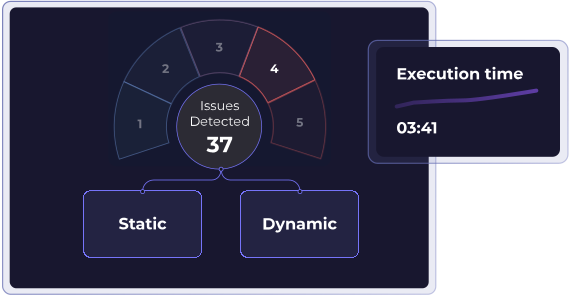
Static & dynamic scanning in a single flow
Combine multi-engine static analysis with dynamic testing against known threat patterns. Together, these methods give you both structural and behavioral insights so you understand not just what the model is, but what it might do.
Detect security gaps in model assets
Inspect model files, weights, and runtime behavior to surface threats you can’t catch with traditional tools. Detect embedded malware, known vulnerabilities in model dependencies, signs of tampering, and unexpected behavior triggered by edge-case inputs.
Secure the future of your AI adoption
You don’t need to slow innovation to control risk.
With DeepKeep, you can enable AI across the business while maintaining visibility and control where it matters.
The business keeps building. You keep it secure.
FAQs
Model scanning analyzes AI models to identify security, safety, and compliance risks. It combines static and dynamic analysis to evaluate both the model’s structure and its runtime behavior.
AI models can introduce risks at any stage of their lifecycle. Model scanning helps organizations detect vulnerabilities early in development and continuously in production as new threats and CVEs are discovered.
It detects risks such as known and emerging CVEs, malware embedded in model artifacts, unsafe behaviors, data leakage potential, and trustworthiness issues including bias and hallucinations. It also identifies licensing risks and insecure serialization methods.
DeepKeep creates comprehensive inventories using SBOM and MLBOM frameworks, providing full visibility into model components, dependencies, and supply chain risks.
DeepKeep uses multi-engine static analysis to inspect model artifacts and dependencies. This enables detection of serialization risks, embedded malware, known vulnerabilities, and licensing issues before the model is executed.
Policy-driven dynamic analysis executes the model in controlled environments to capture full execution traces. This helps uncover runtime behaviors, hidden risks, and interactions that are not visible through static inspection alone.
DeepKeep provides cryptographic assurance through tamper-evident mechanisms and provenance validation, ensuring that models have not been altered and can be trusted throughout their lifecycle.
It delivers unified risk reporting with severity levels, detailed findings, and a clear pass or fail verdict, enabling security teams to make informed decisions quickly.
Yes. DeepKeep’s model scanning is model-agnostic and supports both LLMs and computer vision models, enabling consistent evaluation across different AI systems.
Model scanning should be performed during the development stage before deployment, and continuously in production to identify newly discovered vulnerabilities and evolving risks.
Model scanning focuses on identifying vulnerabilities and weaknesses within the model itself using static and dynamic analysis. AI red teaming simulates real-world attacks to test how models and systems behave under adversarial conditions.