

Automated AI
Red Teaming
Expose vulnerabilities in GenAI through continuous simulation, explainable reporting, and prioritized mitigation
Uncover real risks with automated attack simulations
AI systems can behave in unexpected ways, especially when pushed to the edge. With DeepKeep, you can automatically test your applications, agents and models under real-world conditions without relying on manual red teaming cycles.
Get insights into where systems break down and how to fix them before it matters.

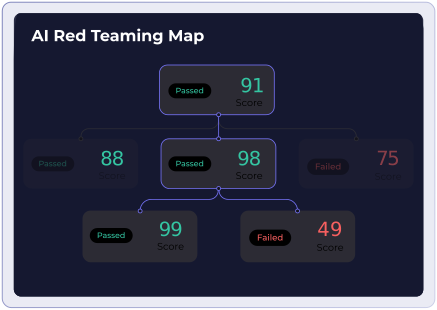
Simulate threats across your GenAI stack
Challenge your AI systems and evaluate how your custom AI applications, models, and agents respond to prompt injection, jailbreaks, data leakage attempts, and unsafe output generation. Tests run contextually and continuously, giving you a realistic view of how GenAI behaves under targeted misuse and not just ideal conditions.
The system adapts to your specific scenario, so you get relevant findings tied to your actual applications, not generic test cases.
Focus on what’s actionable
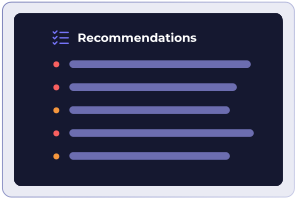
Every red teaming result is tied to a clear security or trust failure, with remediation guidance you can act on. Know which flows are affected, what triggered the failure, and what needs to change - whether that’s a policy update, prompt adjustment, or firewall guardrails. Findings are categorized by impact, so you can focus your effort where it matters most.
Secure the future of your applications
You don’t need to slow innovation to control risk.
With DeepKeep, you can enable AI across the business while maintaining visibility and control where it matters.
The business keeps building. You keep it secure.
FAQs
Automated AI red teaming continuously tests AI models, applications, and agents by simulating real-world attacks. It is context-aware, meaning it evaluates how systems behave within actual usage scenarios to identify vulnerabilities before they can be exploited.
AI systems introduce dynamic and evolving risks that traditional security testing does not address. Automated red teaming enables organizations to proactively identify weaknesses and continuously validate the security and safety of their AI systems.
It identifies a broad range of risks, including prompt injection, jailbreak susceptibility, data leakage, and unsafe outputs. It also evaluates trustworthiness issues such as hallucinations, bias, and inconsistent behavior that can impact reliability and compliance.
Manual testing is limited in scope and frequency. Automated red teaming enables continuous, large-scale testing across diverse attack scenarios, providing wider coverage and faster identification of vulnerabilities.
Yes. DeepKeep’s automated red teaming is model-agnostic and supports both LLMs and computer vision models, enabling consistent evaluation across multimodal AI systems.
Yes. It can be applied both before deployment and continuously in production to detect emerging risks as models, prompts, and usage patterns evolve.
It provides actionable insights and recommended mitigations, allowing teams to strengthen guardrails, refine policies, and improve model behavior based on real attack scenarios.
Findings from red teaming can be used to improve enforcement in the AI Firewall and inform usage policies in AI Lens, creating a continuous feedback loop between testing, visibility, and runtime protection.
AI red teaming helps organizations align with leading standards and frameworks such as GDPR, ISO 27001, OWASP Top 10 for LLMs and AI Agents, and MITRE ATLAS. By continuously identifying and validating risks, it supports audit readiness and strengthens overall AI governance.
Yes. It evaluates model, application and agent behavior across multiple languages, maintaining detection accuracy and ensuring vulnerabilities cannot be exploited through language-based variations.