
AI
Firewall
Enforce runtime security policies on GenAI inputs, outputs, and downstream actions.

An AI Firewall inspects prompts, responses, and agent tool calls in real time to block attacks, prevent sensitive data leakage, and enforce security policies across AI applications and agents.
Runtime protection
AI systems behave differently from traditional applications. They interpret unstructured prompts, generate unpredictable outputs, and may even trigger actions through tools or APIs. This flexibility creates risk and requires runtime control.
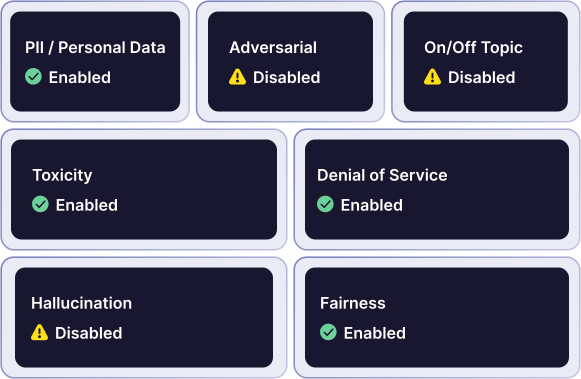
The AI Firewall inspects every interaction as it happens. If something violates your standards, we block, redact or mask it before it turns into a real risk. Otherwise, we alert you.
Customized to your business needs
Your risk tolerance isn’t static and your enforcement shouldn’t be either. Control how violations are handled. You can block unsafe interactions outright, alert the right teams for review, or redact parts of prompts or responses to keep sensitive content out of the model’s reach.
You decide where to be strict, where to monitor, and where to allow flexibility. Everything is logged, auditable, and adjustable.
Stay in control
without slowing down
You don’t need to rewrite apps or retrain models to apply policy. DeepKeep’s firewall integrates at runtime and applies protection dynamically and with context.
Security stays in control. The business keeps moving.
FAQs
An AI firewall is a runtime protection layer that sits between users, applications, and AI models to enforce guardrails in real time. It monitors and controls prompts and responses to prevent risks such as data leakage, prompt injection, jailbreaks, and unsafe outputs.
It protects against AI-specific risks including prompt injection, jailbreak attempts, personal and sensitive data exposure, misuse of tools, and generation of harmful, biased, hallucinated, off-topic or non-compliant outputs.
Yes. The AI Firewall prevents both external leakage and internal exposure between teams, ensuring that personal data is not shared across unintended boundaries.
Yes. DeepKeep is model-agnostic and works across leading LLMs, enabling consistent protection regardless of the underlying model.
It applies context-aware policies to both prompts and model responses in real time. Based on these policies, it can allow, block, redact, or modify interactions to enforce guardrails without disrupting workflows.
DeepKeep supports both inline and out-of-band deployment:
Inline: sits directly in the request path to enforce real-time blocking and prevention.
Out-of-band: uses an orchestrator to monitor and analyze interactions asynchronously, providing visibility, detection, and response without impacting traffic flow.
Yes. DeepKeep provides strong multilingual coverage with consistent detection and enforcement across languages. Based on internal research, it maintains high accuracy in identifying risks such as prompt injection and data leakage in multilingual scenarios, delivering more reliable results compared to LLM-as-a-judge approaches.
DeepKeep supports flexible deployment models, including on-premises and air-gapped environments, allowing organizations to maintain full control over where data is processed and stored. This ensures alignment with strict data residency and sovereignty requirements.
DeepKeep can be deployed as SaaS, in a private cloud, on-premises, or in fully air-gapped environments, depending on security and compliance requirements.